Practical notes on plastic packaging manufacturing: tariffs, materials, certifications, and what actually matters when picking a factory.
Canada regulates cannabis packaging at the federal level under Health Canada, with a stricter and structurally different edible THC limit than any U.S. state. Here's how it actually works.
Ohio's adult-use edible package cap has shifted since the program launched. Here's what's settled, and what's still worth double-checking before you tool.
What Maryland's Cannabis Administration requires for cannabis packaging: CR standards, resealability rules, and the 100mg edible cap.
Missouri added strict color and logo limits on top of standard CR rules. Here's what the Division of Cannabis Regulation actually requires.
What Nevada's Cannabis Compliance Board requires for cannabis packaging: third-party CR lab certification, and the 100mg edible cap.
What Arizona's cannabis packaging statute requires: CR standards tied directly into state law, and the 100mg edible cap.
Massachusetts sets the lowest edible per-serving cap of any major adult-use state. Here's what the Cannabis Control Commission actually requires.
What New Jersey's Cannabis Regulatory Commission requires for cannabis packaging: CR standards, edible shape restrictions, and the 100mg cap.
What New York's Office of Cannabis Management requires for cannabis packaging: CR standards, plain-packaging rules, and the 100mg edible cap.
What Illinois' IDFPR requires for cannabis packaging: CR standards, plain-packaging rules, and the 100mg edible cap.
Michigan's edible THC package cap runs meaningfully higher than most states. Here's what the Cannabis Regulatory Agency actually requires.
What Colorado's Marijuana Enforcement Division requires for cannabis packaging: CR standards, labeling content, and the 100mg edible cap.
Two nearly identical packaging components can carry different duty rates based purely on how they're classified. Here's how HTS codes actually work, and where the legitimate optimization opportunity is.
The $800 duty-free de minimis exemption is gone for every country, not just China. Here's what that means if you're importing small-parcel packaging components.
A CR certification is tied to an exact configuration, not a general design concept. Here's what actually triggers a retest, and what doesn't.
California is moving to formally regulate multipack cannabis goods for the first time. Here's what's actually proposed, and why it isn't final yet.
Pre-roll packaging has to solve freshness, crush protection, and CR compliance at once, in one of the smallest formats in cannabis retail. Here's what actually works.
Private label supplement brands often start on stock packaging and outgrow it. Here's what actually changes when you move to custom.
Brands ask whether PCR content compromises a supplement bottle's protective performance. Here's the honest answer, by resin and by product sensitivity.
Stick packs solve a real consumer behavior problem, but the manufacturing and cost tradeoffs are different from anything bottle-based. Here's what to know before switching.

The Supplement Facts panel has specific FDA formatting rules that eat more label space than most brands plan for. Here's what to budget.

A desiccant packet isn't a universal insurance policy. Here's when moisture control actually protects a supplement, and when it's dead weight in the bottle.
Blister packs and bottles solve the same basic problem differently, and the right choice depends on dose format and use pattern more than brand preference.
An induction seal is one of the cheapest packaging features to add and one of the most consequential to skip. Here's what it actually does.

Supplements don't carry the same federal tamper-evidence mandate OTC drugs do, but nearly every major retailer requires it anyway. Here's the actual regulatory gap.
Most supplements don't need child-resistant packaging, but cross an iron content threshold and CR becomes federally mandated, not optional. Here's the exact trigger.
These three terms get used almost interchangeably in marketing copy, but they describe completely different material properties. Here's the actual distinction.
Lightweighting saves material cost and looks good in a sustainability report, but push wall thickness too thin and the package fails in the field. Here's the real limit.
Production at real volume runs differently than a sample order. Here's what actually changes once you cross into six-figure unit counts.
"Barrier film" isn't one material, it's a layered structure where each layer does a different job. Here's what actually blocks what.
The pouch format decision affects shelf presence, material cost, and fill-line speed differently. Here's how to weigh it.
Sink marks show up worst on exactly the high-gloss cosmetic surfaces where they're least acceptable. Here's how draft angle and wall thickness prevent them.
Cosmetic labels have real federal requirements, separate from FDA drug rules, and they affect how much label real estate your packaging needs to leave. Here's what applies.
A custom cosmetic bottle mold isn't priced or scheduled the same way a stock bottle order is. Here's what actually drives the number.
PCR resin in cosmetics packaging comes with real trade-offs in clarity and odor that don't show up in a sustainability pitch deck. Here's what to actually expect.
The closure style on a cosmetic package affects dispensing control, shelf presence, and unit cost more than most brands budget for upfront. Here's how to choose.
A closure that doesn't seat right usually traces back to a neck finish mismatch. Here's how SPI and PCO standards actually work.
Soft-touch closures and grips depend on the overmold actually bonding to the substrate. Here's what makes that bond work, and what breaks it.
More cavities means more output per cycle, but also more tooling cost and tighter tolerance to hold. Here's the volume threshold where it actually pays.
Shaving seconds off a molding cycle compounds fast at volume. Here's where those seconds actually come from, and where they don't.
The steel your mold is cut from determines its lifespan, cost, and how well it holds a cosmetic finish. Here's how to choose.
Cosmetic-grade resin isn't a marketing label. Here's what actually changes between grades, and when paying for it is worth it.
Regrind cuts material cost, but push the ratio too far and you get brittleness, inconsistent color, and failed parts. Here's where the line actually is.
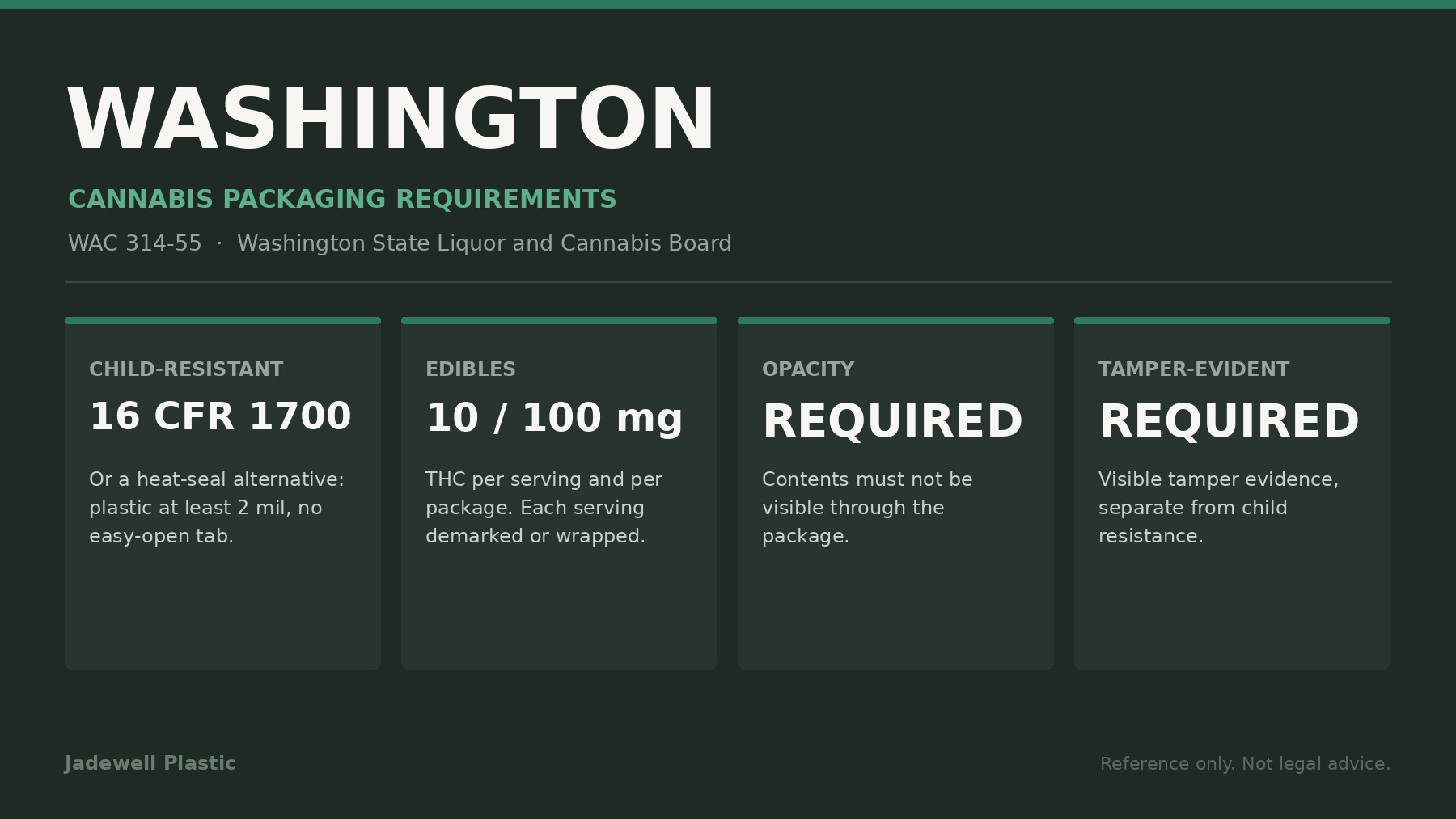
What California's DCC actually requires for cannabis packaging: CR certification standards, the universal symbol, and the 100mg edible cap.
Section 122 expired July 24. Here's what USTR's new Section 301 tariffs actually cost for plastic packaging sourced from China versus Vietnam.
How Pantone color targets translate into masterbatch dosing for molded plastic parts, and why the first production shot rarely matches the swatch exactly.
Injection molding and blow molding start from opposite processes and produce different kinds of parts. Here's which one your packaging design needs.
PP, HDPE, and PET behave differently under stress, chemicals, and heat. Here's how to choose the right packaging resin before you cut a mold.
Sourced tariff numbers on plastic packaging from China versus Vietnam, and how the Section 122 baseline rate has shifted since July 2026.