

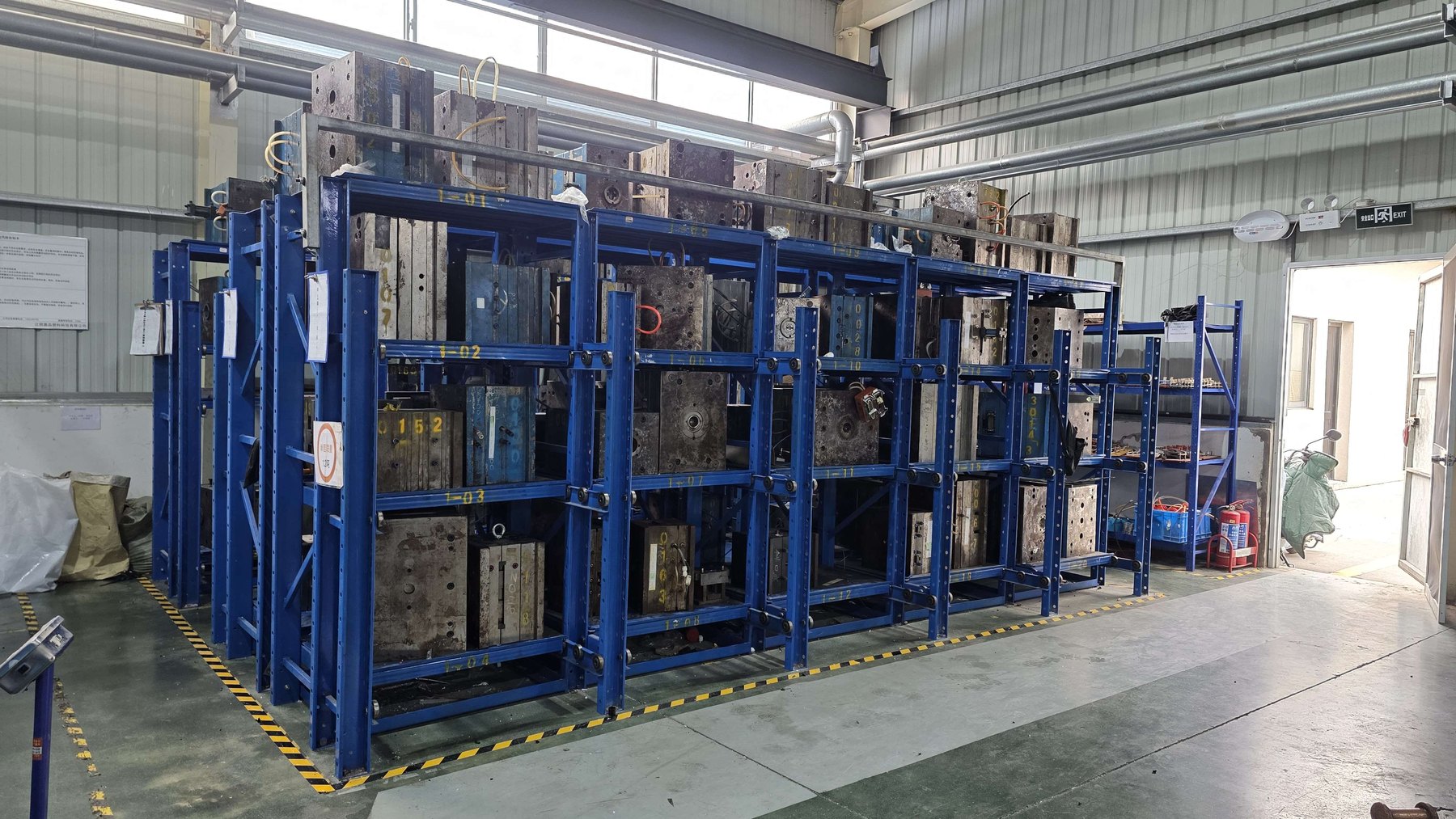
Tooling is the steel mold that forms a plastic part. In packaging, buyers choose between stock tooling and custom tooling at the start of every new program.
Stock tooling means the mold already exists, belongs to the manufacturer, and produces a standard shape shared across many customers. Common bottle, jar, and closure formats all run on stock steel. Custom tooling means the mold is cut specifically for one buyer's design, and the resulting shape belongs to that buyer alone.
Both paths are legitimate, and the choice comes down to annual volume, product margin, expected SKU life, and how much the container itself contributes to the brand. This article walks through the cost structure of each and the arithmetic that separates them.
Stock tooling carries no mold charge, because the manufacturer absorbed that cost across earlier programs. Several advantages follow from that:
That last point deserves attention, because a first article off new custom steel can reveal sink marks, weld lines, or short shots requiring corrections and a second trial. Stock tooling removes that design-for-manufacturability exposure entirely.
Custom tooling costs more upfront and takes longer to reach production. It earns that premium in four ways:
Cavitation is the benefit buyers most often overlook. A stock mold runs at whatever cavity count suited the manufacturer's original customer. A custom tool sized to a 500,000-unit program completes fewer cycles for the same output, which reduces machine time per unit.
Tooling cost varies with cavitation, steel grade, part complexity, and whether the mold requires unscrewing cores or a hot runner system.
As a general range, a multi-cavity PET blow mold in S136 stainless runs a few thousand dollars, while a high-cavitation closure mold in H13 tool steel can reach $10K or more. Fabrication takes roughly 25 to 40 days, followed by 7 to 10 days to first sample.
Payment is customarily split, with half against the purchase order and half against approved T1 sign-off. Buyers should plan for that capital to leave early in the program.
Steel grade determines how long the tool survives, which bears directly on the amortization question below. Class 101 hardened steel molds are rated up to 1,000,000 shots. Class 102 and 103 molds in pre-hardened steel or aluminum are rated between 100,000 and 500,000 shots and cost considerably less.
The decision usually resolves once tooling cost is divided across realistic annual volume and expressed as a per-unit figure.
Consider a 120 ml PET cosmetic bottle quoted around $0.14 FOB. Assume a $4,500 blow mold for illustration:
This is the arithmetic behind the 100,000 to 250,000 unit threshold commonly cited in packaging sourcing. Above that range, tooling stops meaningfully distorting cost of goods.
Two variables shift the threshold, and product margin is the first, since a premium skincare SKU absorbs a packaging premium that a commodity program cannot. Expected SKU life is the second, and buyers frequently miscalculate it by amortizing across a single year. A tool running three years at 80,000 units annually amortizes across 240,000 units, which clears the threshold comfortably.
Jadewell's guidance on how tooling cost lands on a quote covers whether to carry the charge as a separate line item or fold it into piece price. A separate line item gives the buyer clearer visibility into true unit economics.
Buyers commonly treat this decision as binary. However, a middle path exists, and it is rarely volunteered during quoting.
Modified stock keeps an existing tool in service while changing selected features. Four approaches cover most requirements:
Modified stock typically costs a fraction of full custom tooling and shortens the schedule considerably. Therefore, buyers should price it as a third option before committing to either extreme.
Insert work changes surfaces while core geometry stays fixed, and buyers should understand where that boundary sits before requesting a quote.
Adding an embossed logo or an engraved cavity number is inexpensive. Altering wall thickness, parting line position, or shrinkage behaviour requires re-cutting the core, at which point cost approaches a full custom tool and should be quoted as one.
A revised neck finish carries a further consideration. Closure fit and application torque both require re-qualification, so buyers should budget a second sampling round before production release.
Tooling is a capital asset, and the purchase order should treat it as one. Three terms belong in writing before a deposit is released:
Suppliers who discount tooling against piece price often retain title to the mold. That arrangement lowers the invoice while limiting the buyer's ability to move production later. Therefore, ownership terms are worth confirming during quoting.
Six questions resolve most stock-versus-custom decisions:
Programs validating product-market fit, or competing primarily on speed, are generally well served by stock tooling. Capital stays in inventory and demand generation until volume proves out. Migration to custom tooling remains available once the SKU establishes itself.
Programs with established volume, premium positioning, or functional requirements outside stock hardware justify custom tooling. Once several competitors occupy the identical stock bottle, packaging stops contributing to brand recognition, and the case for custom steel strengthens considerably.
The quote-to-production timeline covers what each path looks like week by week.
Jadewell maintains a stock mold library for fast-turn programs, quotes modified-stock options on request, and operates an in-house tooling shop covering CAD/CAM mold design, CNC machining, and EDM wire cutting.
Rapid aluminum pilot tooling is available for market testing ahead of a production mold. Molds are built to Class 101, 102, or 103 depending on expected program life, and tooling appears as a separate one-time line item on every quotation.
Manufacturing runs from facilities in Jiangyin, China and Hai Duong, Vietnam, with pricing quoted FOB Shanghai or FOB Haiphong.
Browse the open-stock formats available without a mold charge, or request a quote with annual volume and target timeline for side-by-side pricing on stock, modified stock, and custom tooling.