

The Washington State Liquor and Cannabis Board regulates cannabis packaging statewide under WAC 314-55. Its baseline requirements track closely with California's and Oregon's, child-resistant, tamper-evident, no youth-appealing design, but Washington offers a packaging-specific alternative that neither neighboring state spells out in the same form.
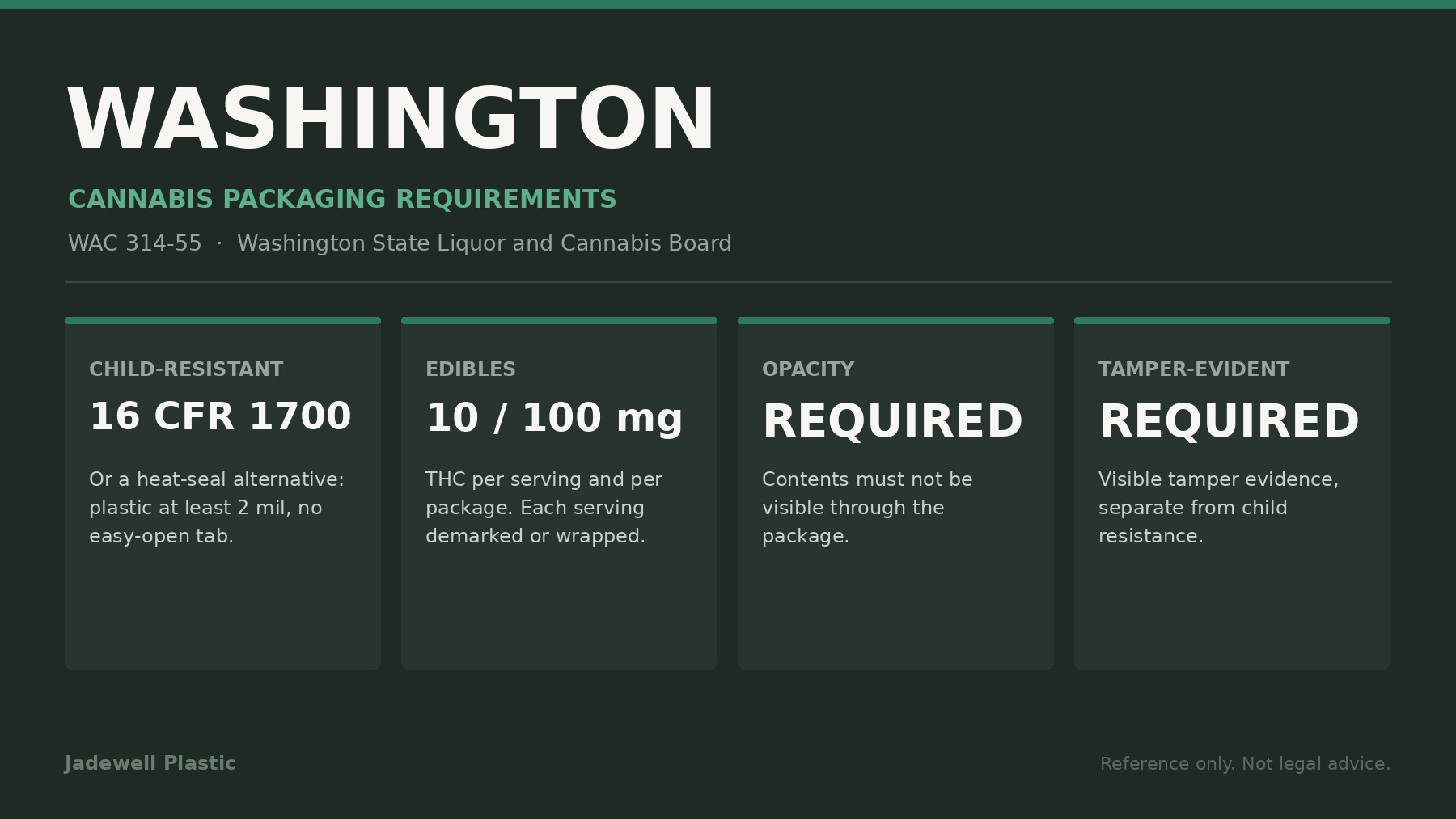
Washington requires cannabis packaging to meet the federal Poison Prevention Packaging Act standard, 16 CFR Part 1700, difficult for children under five to open while remaining usable for adults. Across concentrates, solid edibles, and liquid edibles, Washington also allows an alternative path: packaging in plastic at least 2 mils thick, heat-sealed with no easy-open tab, dimple, corner, or flap. That gives packagers a second, non-mechanical route to compliance that applies across product categories, and it puts flexible packaging on the table alongside rigid CR closures.
Cannabis products in Washington cannot resemble candy or commercially available food items, and packaging cannot use imagery that appeals to minors. Products require visible tamper-evidence and must keep contents from being visible through the package, consistent with the opacity standard used across the West Coast.
Washington labels need THC and CBD content per serving and per package, a universal cannabis symbol, batch number, testing results, and specific government warning language, including "This product has intoxicating effects" and "Not for sale to persons under age 21." Labels also require the licensee's name and license number, net weight, and a full ingredient and allergen list.
Washington caps edibles at 10 milligrams of active delta-9 THC per serving and 100 milligrams per package under WAC 314-55-095, matching California's and Oregon's current limits. Each serving has to be physically demarked, scored, or individually wrapped so a consumer can identify a single dose without guessing.
Washington, California, and Oregon now share the same 10-milligram-per-serving, 100-milligram-per-package edible ceiling, so a single format generally clears all three states on dosing; CR certification path and label content are where the states still diverge. For the full comparison, see Cannabis Packaging Regulations in California and Cannabis Packaging Regulations in Oregon. For CR mechanism selection generally, see What Child-Resistant Packaging Actually Requires. This article reflects currently published WSLCB regulations as of July 2026 and provides general information only; confirm current requirements with the WSLCB or cannabis regulatory counsel before finalizing packaging for production.
Sources: Washington State Legislature, WAC 314-55-105 (cannabis product packaging and labeling); WAC 314-55-095 (THC-infused product serving size).
For state-specific tooling, see Jadewell's cannabis packaging capabilities, or request a quote.