

The Oregon Liquor and Cannabis Commission regulates cannabis packaging statewide. Its rules share the same broad shape as California's and Washington's, child-resistant, tamper-evident, opaque, no youth-appealing imagery, though Oregon documents CR certification more explicitly than some other states.
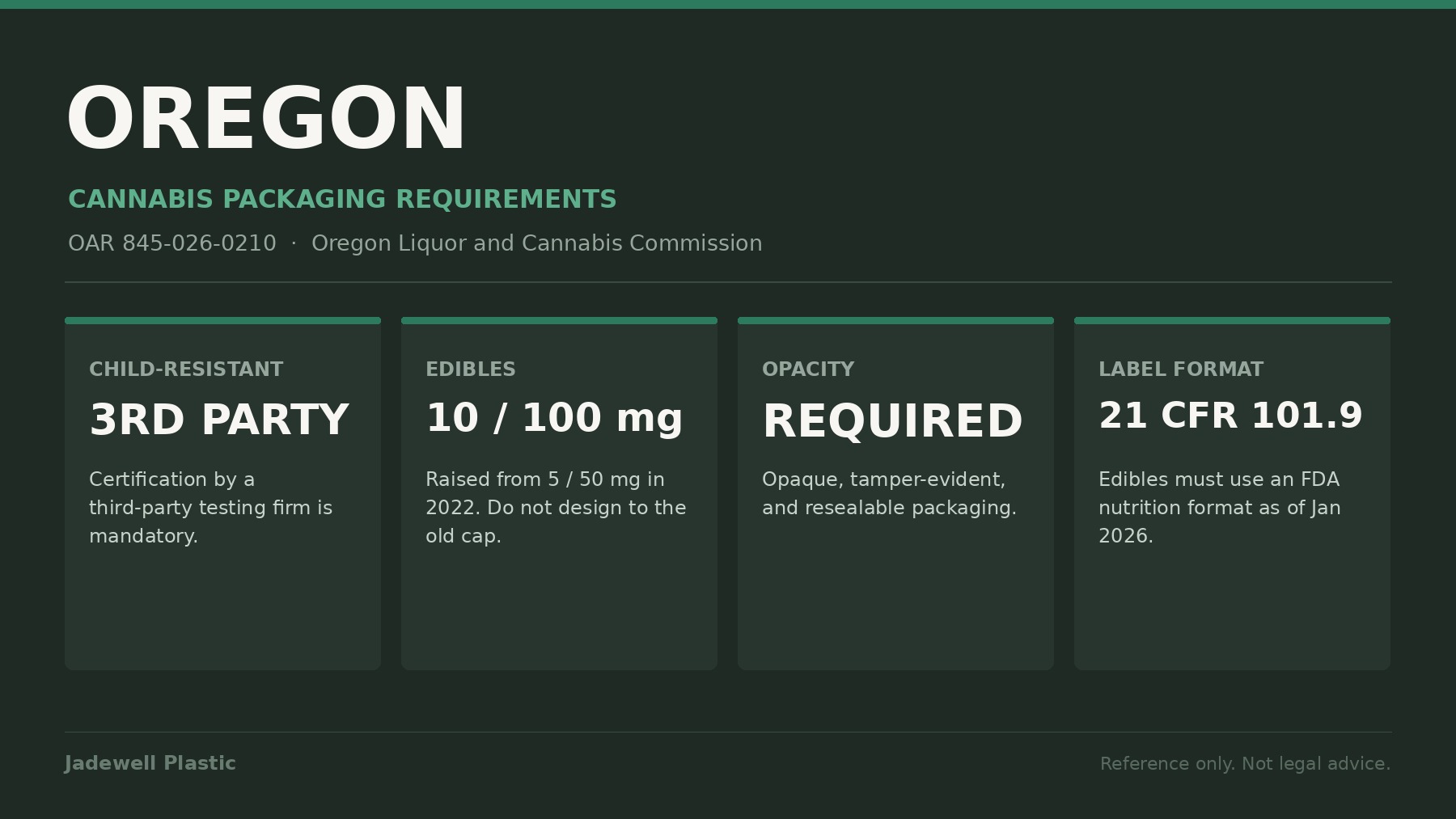
All marijuana and hemp cannabinoid items leaving a retail store, other than immature plants and seeds, have to be in child-resistant packaging. Oregon requires that CR packaging be tested and certified by a third-party testing firm before the OLCC will recognize it, which puts the certification documentation more explicitly on the packager's side of the paperwork than some other states' rules do. Keep that certification on file and tied to the exact package configuration it was tested against.
Oregon requires opaque, tamper-evident, resealable packaging for cannabis products. Edibles specifically cannot resemble commercial candy, and packaging broadly cannot use images of minors, cartoons, or other designs built to appeal to children.
Oregon cannabis labels need THC and CBD content per serving and per package, the OLCC's universal symbol, batch number, testing results, and government warning language. As of January 1, 2026, Oregon added a new requirement specific to edibles: cannabinoid and hemp edibles now have to use one of the standard nutrition information formats under 21 CFR 101.9(c), the same format the FDA uses for food nutrition facts panels, layering a food-labeling format on top of the existing cannabis label requirements.
Oregon raised its edible THC limits effective January 2022: a retail cannabinoid edible is now capped at 10 milligrams of total delta-9 THC per serving and 100 milligrams per package, the same ceiling California and Washington use. Oregon's earlier limits, 5 milligrams per serving and 50 milligrams per package, no longer apply and should not be used as a design target. Edibles at or under 55 milligrams per package get somewhat more flexibility in how a single serving is identified, scoring, a measuring device, or clear packaging demarcation; above that threshold, scoring or a measuring device is required.
Because Oregon's current edible cap now matches California's and Washington's, a single 100-milligram, ten-serving format generally clears all three states without a state-specific redesign on dosing alone. Oregon still diverges on CR certification documentation and labeling format. For how California and Washington compare, see Cannabis Packaging Regulations in California and Cannabis Packaging Regulations in Washington. For CR mechanism selection generally, see What Child-Resistant Packaging Actually Requires. This article reflects currently published OLCC regulations as of July 2026 and provides general information only. Confirm current requirements with the OLCC or cannabis regulatory counsel before finalizing packaging for production.
Sources: Oregon Administrative Rules OAR 845-026-0210 (concentration and serving size limits); Oregon Liquor and Cannabis Commission, Marijuana Packaging and Labeling.
Explore the Jadewell cannabis packaging capabilities, including child-resistant jar and closure formats, or request a quote to confirm CR availability for a given format.