

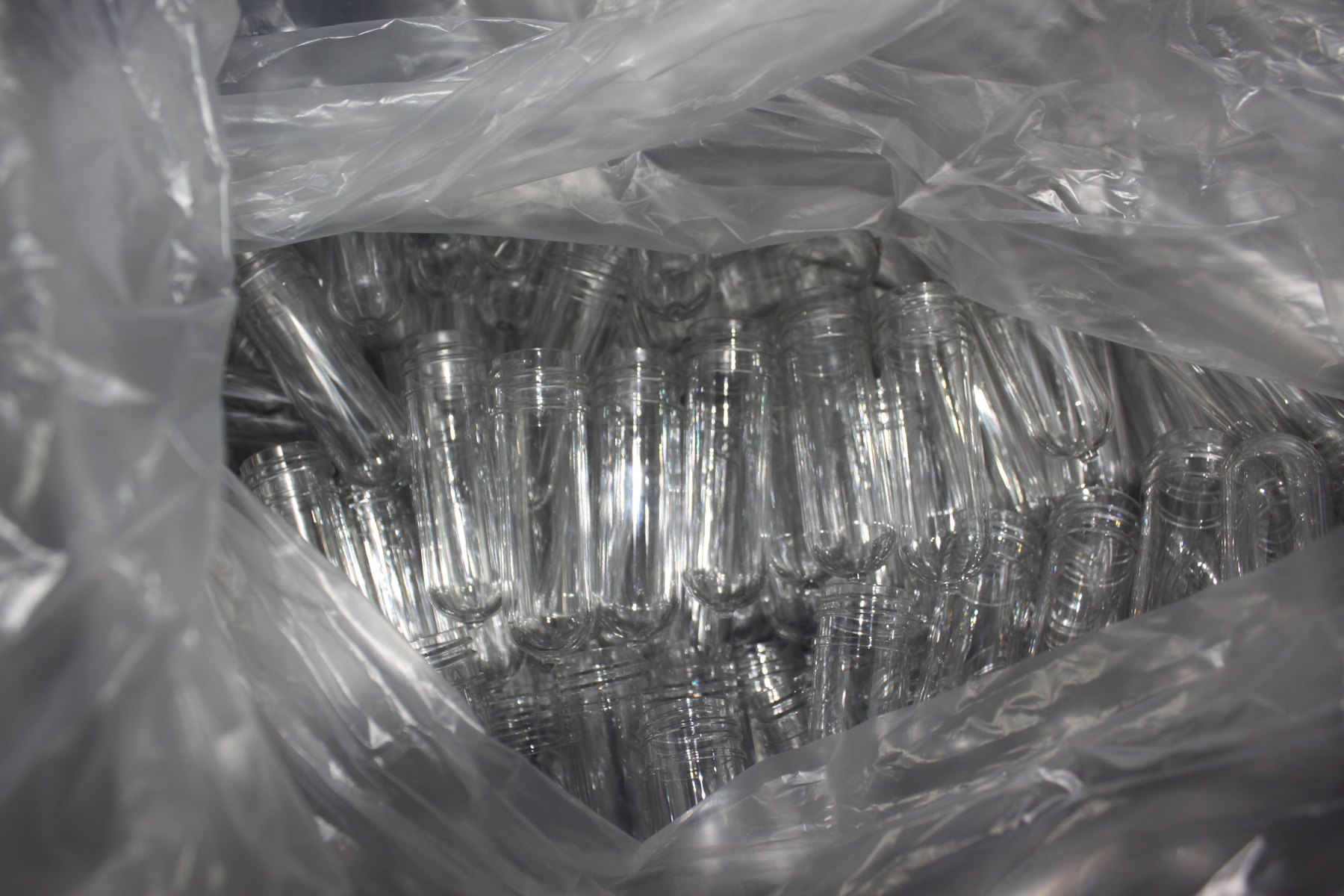
Every clear PET bottle starts life as a small, thick-walled part that looks like a test tube. Understanding how that preform is engineered, how it becomes a bottle, and what happens to it in between explains most of the quality problems buyers encounter on PET programs.
A PET preform has a fully formed, finished neck and threading sitting above a thick-walled, rounded body section that has not been shaped yet.
This is the part buyers most often misunderstand. The preform's neck finish is already final and precise. Threading and sealing surfaces are not stretched or altered in the next stage. Everything below the neck is a deliberately over-thick reservoir of material waiting to be stretched into its final geometry.
Because the preform mold defines the finished neck finish permanently, injection mold tolerances on that section are tighter than almost anywhere else on the tool. Thread pitch, sealing surface diameter, and overall neck height all have to match the target closure exactly, because no secondary forming step corrects neck geometry later.
A preform mold with a slightly out-of-spec neck produces bottles with capping problems on every single unit from that cavity. This is why neck finish compatibility gets confirmed before tooling.
The body section of a preform is engineered so that when the part is reheated and stretched, material redistributes into the finished bottle's wall thickness profile predictably.
Getting that starting distribution wrong shows up downstream as thin spots, uneven clarity, or structural weak points in the finished bottle — problems far more expensive to catch after blow molding than at the preform stage.
ISBM starts by reheating a cooled preform to a narrow temperature window: hot enough for the PET to become pliable and orient properly, but not so hot that it loses the structural memory needed to hold its final shape.
Getting that reheat profile even across the whole preform matters. Uneven heating produces uneven wall thickness and clarity in the finished bottle.
Once reheated, the preform moves into the blow mold, where a stretch rod mechanically pushes down through the centre of the part, elongating it vertically before air pressure ever engages.
This mechanical pre-stretch is what triggers biaxial orientation, aligning PET's polymer chains in both the vertical and, shortly after, the radial direction. That orientation is the source of PET's characteristic clarity and strength.
With the stretch rod extended, high-pressure air inflates the softened preform outward against the blow mold cavity walls, completing the radial stretch and pushing material into its final geometry — including panel details, grip texture, or label flats built into the mold. The whole stretch-and-blow sequence takes a few seconds per part.
The same stretching that gives PET bottles their glass-like clarity also significantly increases tensile strength and gas barrier performance compared with an unstretched part of the same wall thickness.
This is why ISBM lets PET bottles run thinner walls than an equivalent extrusion blow molded HDPE bottle while still holding pressure and resisting impact. The orientation process is doing structural work, which is also why lightweighting goes further on PET than on most other resins.
Extrusion blow molding, the process typically used for HDPE and LDPE bottles, inflates a continuously extruded tube of molten plastic directly, with no separate preform stage and no biaxial stretch step.
That makes EBM well suited to opaque, squeezable containers but unable to match ISBM's clarity and strength-to-weight ratio, which is why virtually every clear PET cosmetic and beverage bottle runs through ISBM. For a full comparison, see Injection Molding vs. Blow Molding.
Preform injection molding and stretch blow molding do not have to happen on the same machine, or even at the same facility. Preforms are frequently molded, cooled, and packed for shipment to a separate blow molding operation, sometimes across considerable distance. That is viable because a fully cooled preform is a stable intermediate product, provided it is properly packed.
When a preform's surface is scuffed or scratched by contact with other preforms during handling or transit, that damage stretches along with everything else during blow molding. A minor scratch on a preform's shoulder can stretch into a visible line or haze streak on the finished bottle — a defect on a part that already passed injection molding quality control.
Loose preforms in bulk bins or gaylord boxes rub against each other constantly during transit, loading, and storage. Clear, high-gloss PET is particularly unforgiving, since any surface abrasion becomes visible once the part is stretched and placed under studio or retail lighting. A textured or opaque part might hide the same scratch entirely.
Automated bagging equipment slips each preform into its own poly sleeve immediately after the part cools and clears the mold, before it can contact another preform. The step runs in-line at production speed, so it introduces no meaningful bottleneck, and it eliminates preform-to-preform contact for the entire transit and storage window.
For a commodity HDPE program with an opaque finish, this matters little. For a clear cosmetic PET line where surface finish is part of shelf presence, it is the difference between a first-pass yield that holds up and one that generates avoidable rejects at final inspection.
Jadewell bags preforms individually as standard practice on clear and high-gloss cosmetic programs, and runs both preform injection and stretch blow molding in-house so parts do not accumulate handling damage crossing between vendors.
Explore Jadewell's plastic bottle and cosmetics packaging capabilities, or request a quote with the bottle geometry, neck finish, and clarity requirement.