

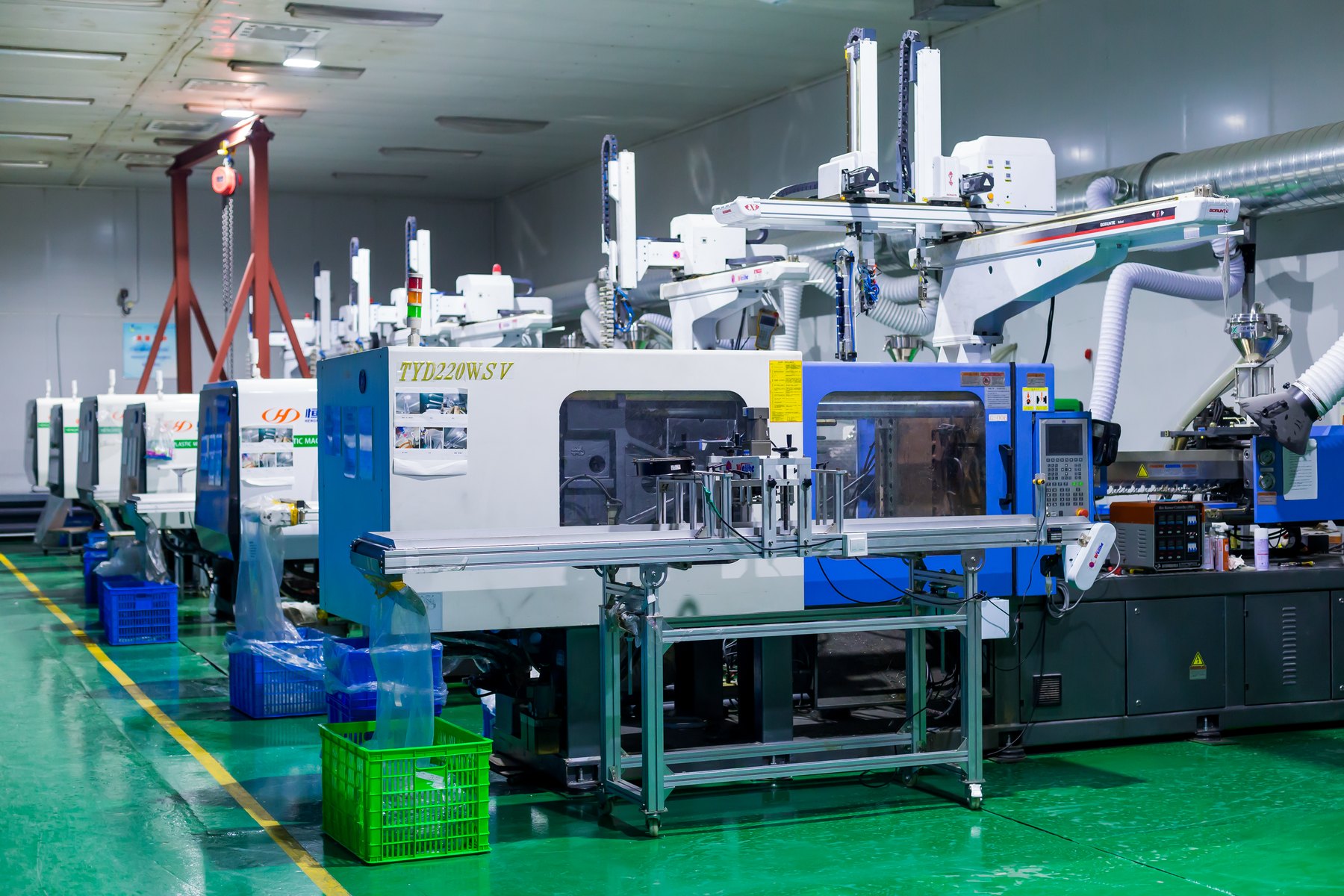
Raw plastic arrives at a factory as small pellets, roughly the size of a grain of rice, packed in bulk bags or gaylord boxes. These pellets are the resin in its most basic form, whether that is PP, HDPE, LDPE, PET, or TPE.
They carry no color or additives yet unless pre-compounded. Color, UV stabilizers, and any PCR content get blended in at this stage, either by the resin supplier or on-site through a dosing system feeding directly into the molding machine.
Pellets feed into a hopper on top of the molding machine and drop into a heated barrel. A rotating screw both melts the resin and pushes it forward under pressure. How easily it flows at that point is a measurable resin property, and melt flow index is the number that describes it.
What happens next depends on the process. In injection molding, the molten plastic gets injected directly into a closed steel mold and holds its shape as it cools.
In blow molding, it either forms a hollow tube that gets inflated inside a mold, or gets shaped first into a preform that is reheated and stretched with air later. Either way, the part is fully formed within seconds to a couple of minutes, depending on wall thickness and part size.
Cooling is actively controlled. Molds have internal channels running water at a controlled temperature to pull heat out of the part evenly, since uneven cooling is what causes warping and sink marks.
Once the part is rigid enough to hold its shape, the mold opens and ejector pins push the finished piece free. A single mold runs this cycle thousands of times a day depending on part size and cooling time, which is why cavity count and cycle time drive per-unit cost more than resin price does.
From here, parts move to secondary operations if the design calls for them: silk-screen printing, hot foil stamping, pad printing on curved surfaces, or a matte or soft-touch spray coating.
Multi-component parts get assembled at this stage too. A bottle with a separate pump, or a jar with a liner, both come together here, downstream of the molding press.
Quality control runs throughout the process. Vision systems check wall thickness, weight, and visual defects against spec before parts are packed for shipment.
Finished parts get boxed, palletized, and moved out, typically FOB Shanghai or FOB Haiphong depending on whether the order ran at the Jadewell China or Vietnam facility.
From raw pellet to a palletized, ready-to-ship bottle, the process takes minutes per part. Getting there reliably at scale is the actual work of running a factory.
Jadewell runs injection and blow molding at both plants, across the full commodity resin range. Request a quote with the part geometry, resin, and annual volume.