Spec sheets and quotes get thrown around full of shorthand that nobody explains. This glossary breaks down the resin codes, molding terms, and bottle anatomy vocabulary that come up when sourcing custom plastic packaging, so a quote or a mold drawing can be read without guessing.
Resin Identification Codes (1-7)
Every resin has an SPI code, usually molded into the base of the container inside the recycling triangle. The list below covers what each number means and where it shows up in packaging.
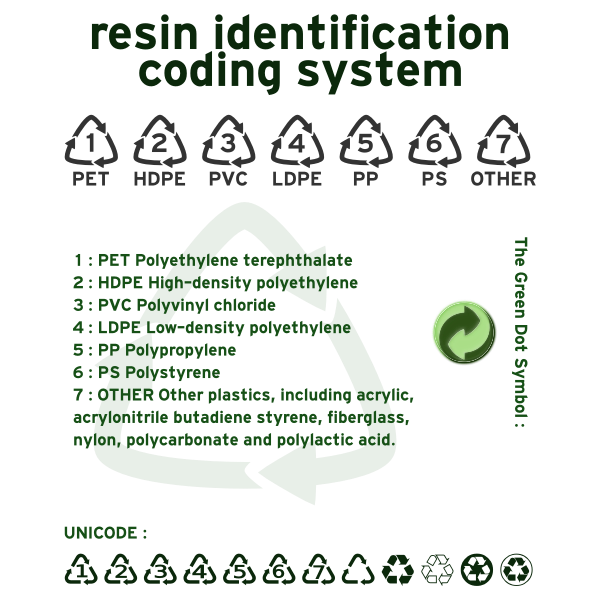
- 1 - PETE/PET: Polyethylene terephthalate. Glass-like clarity, strong gas barrier, standard for water bottles, cosmetic bottles, and food containers. PETG, the glycol-modified copolyester used when a thick wall has to stay clear, also carries code 1, but it is not accepted in most PET recycling streams.
- 2 - HDPE: High-density polyethylene. Chemical-resistant, opaque or translucent, the workhorse resin for squeeze bottles, wide-mouth jars, and cannabis packaging.
- 3 - PVC: Polyvinyl chloride. Rare in new packaging designs due to chlorine content and processing complexity. Mostly legacy tubing and blister packs.
- 4 - LDPE: Low-density polyethylene. Flexible, used for squeeze tubes, bags, and film. Softer than HDPE with lower tensile strength.
- 5 - PP: Polypropylene. High chemical resistance, handles sterilization heat, and molds living hinges. The default for flip-top caps and closures.
- 6 - PS: Polystyrene. Rigid and low-cost, used for some jars and clamshells. Brittle compared to PP or HDPE.
- 7 - Other: Includes PC, SAN, acrylic, TPE, and multi-material blends. Common in soft-touch overmolded caps and specialty components.
Molding Process Terms
- Injection molding: Molten resin is injected into a closed steel mold under pressure, then cooled and ejected. Used for caps, closures, jars, and small rigid parts.
- Extrusion blow molding (EBM): A hollow tube of molten resin (a parison) is inflated inside a mold to form a bottle. Standard process for HDPE bottles.
- Stretch blow molding (SBM): A preform is reheated, stretched axially, then blown to final shape. Used almost exclusively for PET bottles to get clarity and strength.
- Gate: The point where molten resin enters the mold cavity. Gate placement affects flow lines, weld lines, and cosmetic appearance.
- Parting line: The seam where the two mold halves meet. Every molded part has one; good tooling keeps it thin and symmetrical.
- Draft angle: The taper built into vertical walls so a part releases from the mold without dragging. Jadewell specs a minimum of 1-2 degrees on most tooling.
- Shrinkage: The percentage a part contracts as it cools from molten to solid. Varies by resin (HDPE shrinks more than PET) and must be built into the mold dimensions.
- Cycle time: The total time to mold one part, from injection or blow through cooling and ejection. Directly drives unit cost at volume.
- Cavity: A single mold impression. Multi-cavity tools (2, 4, 8+ cavities) produce more parts per cycle and lower per-unit tooling amortization.
- Sink mark: A shallow depression on a part's surface caused by uneven cooling, usually where wall thickness changes abruptly.
- Weld line: A visible seam where two flow fronts of molten resin meet and re-fuse. Can be a cosmetic issue or, in the wrong location, a structural weak point.
- Living hinge: A thin, flexible strip of resin (almost always PP) that lets a lid flex open and closed thousands of times without cracking.
Bottle Anatomy
- Finish: The threaded top portion of a bottle that accepts a closure. Defined by a finish code (e.g., 20-410, 24-415) covering diameter and thread type.
- Neck: The narrowed section between the shoulder and the finish.
- Shoulder: The sloped transition from the neck down to the body.
- Body/panel: The main volume of the bottle, often with flat panels for labeling.
- Base: The bottom of the bottle. Push-up or champagne bases add stability and reduce resin use in the center.
- Bead: A raised ring below the finish, sometimes used to secure a tamper band or as a design element.
Closure and Fitment Terms
- CR (child-resistant): A closure mechanism, usually push-and-turn or squeeze-and-turn, meeting 16 CFR 1700 testing standards. Standard on cannabis packaging.
- Induction seal: A foil liner heat-sealed to the bottle finish under the cap, providing tamper evidence and a moisture/vapor barrier.
- Tamper-evident band: A perforated plastic band connecting cap to bottle that must be broken to open, showing the container hasn't been opened.
- Orifice reducer: An insert that limits flow rate and controls dosage, common on dropper and oil bottles.
- Fitment: Any insert or secondary component (pump, sprayer, dropper, or reducer) that sits inside or on top of the primary closure.
Put the Vocabulary to Work
Knowing the terms is step one, and applying them to an actual container, resin, and volume requirement is where the savings show up. Jadewell molds out of dual facilities in China and Vietnam, runs mold flow simulation before cutting steel, and offers low-MOQ trials before committing to full tooling. Browse the stock catalog if a standard format will do the job, or request a quote with the container spec, resin, and volume.