

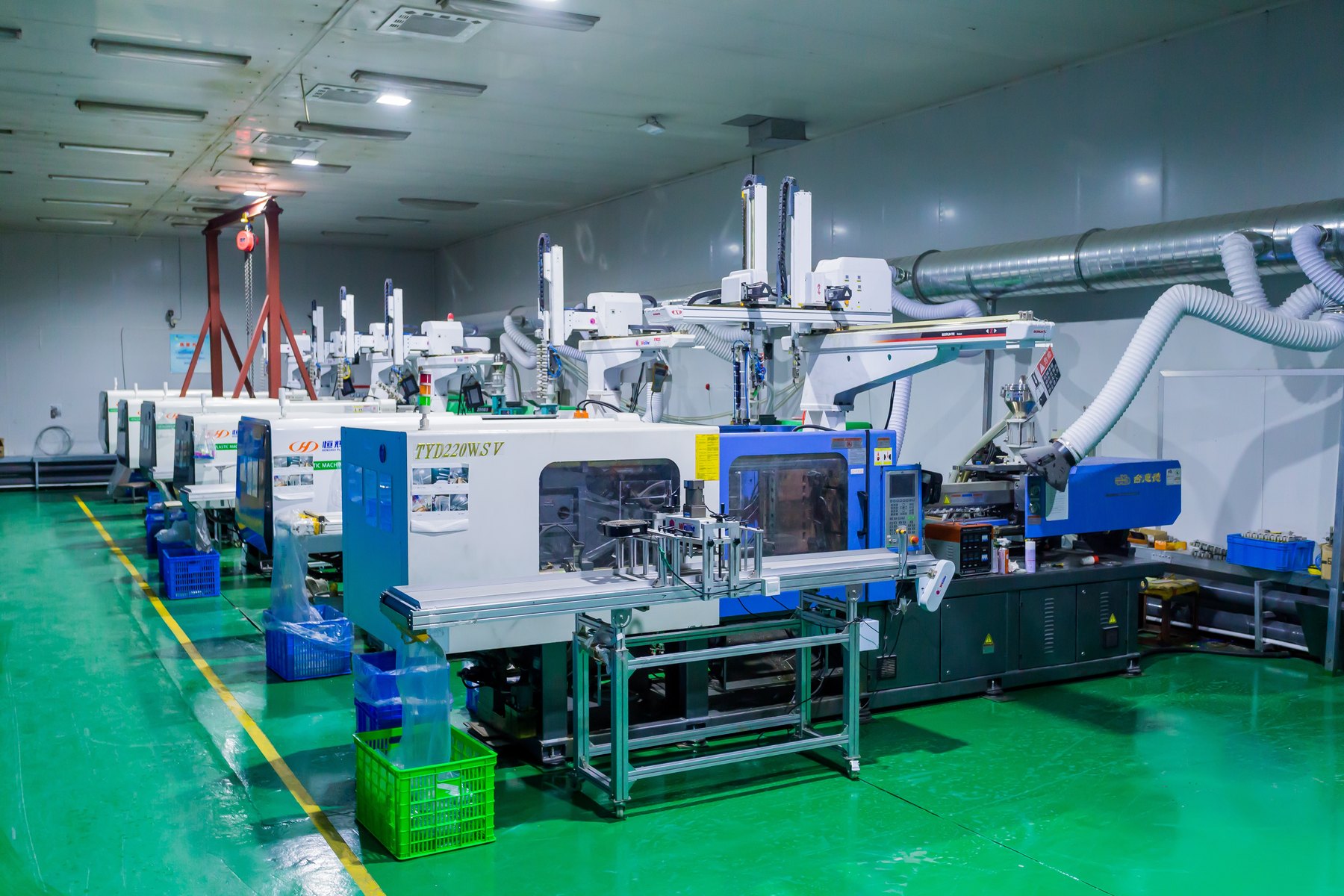
In most injection molding cycles, cooling accounts for 50 to 70 percent of total cycle time, far more than injection or packing.
The fastest path to a shorter cycle is almost always better mold cooling design: conformal or optimized cooling channel layout. A part cooling inefficiently because of poor channel placement bottlenecks the whole cycle regardless of how quickly the barrel fills the cavity.
Cooling time scales roughly with the square of wall thickness. A part designed at 2.5 millimeters can cool closer to 50 percent slower than the same part at 2.0 millimeters, well past the 25 percent the thickness increase alone would suggest.
Where structural requirements allow it, wall thickness reduction is often the single highest-leverage change available for cutting cycle time at scale, beating most machine-side process tweaks. The wall thickness fundamentals apply directly here.
Different resins shed heat at different rates. PP and HDPE hold more heat through a thick section than an equivalent amorphous resin, so a semi-crystalline part carries a longer cooling floor no matter how good the channel layout is. Grade selection and cycle target belong in the same conversation.
Once cooling and wall thickness are addressed, machine-side gains come from optimized pack-and-hold profiles, minimizing unnecessary hold pressure duration, and reducing mold-open dwell time for part ejection and handling.
These are real but generally smaller gains, often single-digit percentage improvements, compared to geometry-level changes.
On a part running a 20-second cycle at 500,000 units a year, cutting even 2 seconds through cooling optimization recovers roughly 10 percent of annual machine time on that tool.
That is capacity that can run another job or reduce billed press-hours. At high volume, cycle time engineering is a direct capacity and cost lever. It compounds with cavity count, since both multiply parts per hour off the same press.
Cooling channel layout and wall thickness get decided during design for manufacturability, before tooling starts. Retrofitting cooling improvements into a built mold is expensive and often only partially effective.
Steel choice interacts here too, since thermal conductivity varies by grade and the steel selected partly determines how fast heat leaves the cavity.
Jadewell runs conformal cooling layouts on high-cavitation tooling for commodity bottle and closure programs. Request a quote with the annual volume, part weight, and wall thickness.