

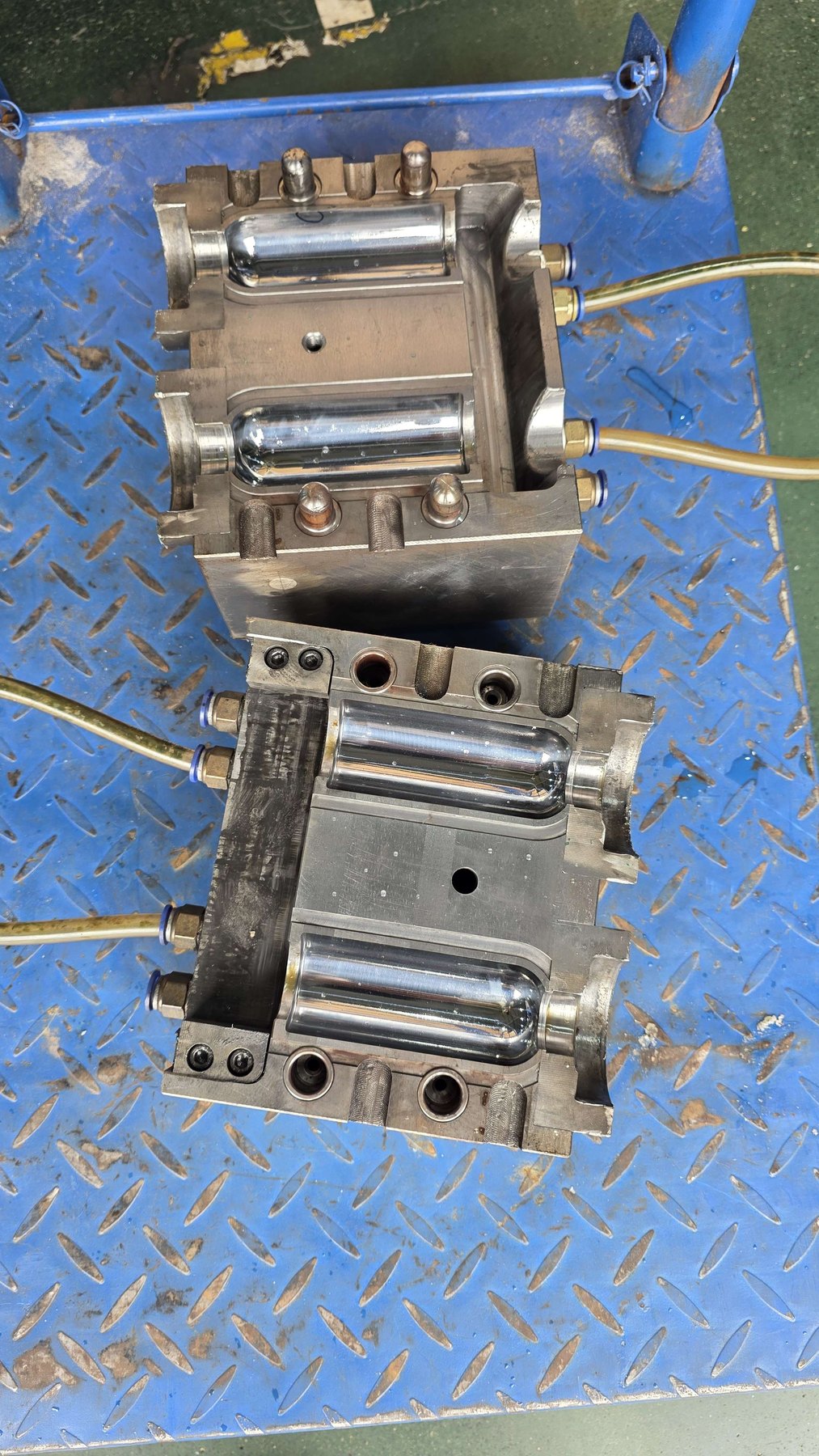
Most expensive mold revisions trace back to a small set of avoidable decisions made before tooling was ever cut. Wall thickness, draft angle, and gate placement get locked into steel when the mold is machined, and changing any of them afterward means modifying hardened tooling. What follows covers the underlying physics, the review checklist that catches problems on paper, and what changes when the part carries a high-gloss cosmetic finish.
Wall thickness is usually the first number locked into a design, and it drives cooling time, material cost, and cosmetic quality simultaneously.
Thick sections cool from the outside in. The outer skin solidifies well before the core does, and as the core finally cools and shrinks, it pulls the outer surface inward with it. That is a sink mark: a shallow dimple on the face opposite a rib, boss, or thick section.
Consistency matters more than any single target number. Uneven thickness is what actually causes uneven cooling, warping, and sink. Where a transition is unavoidable, taper it gradually.
Acceptable thickness depends on resin. PP fills thin sections readily and tolerates a thinner wall at a living hinge than HDPE will. HDPE needs more generous walls to avoid short shots at the same flow length. How readily a resin fills a thin section before freezing off is captured by its melt flow index, which is why grade selection and wall specification get decided together.
Shrinkage rates vary widely by resin too. The same geometry behaves differently in HDPE at 1.5 to 3 percent than it does in PET at roughly 0.3 to 0.5 percent.
Every vertical wall on a molded part needs a slight taper, called draft, so the part releases from the mold without dragging or scuffing on the way out.
Without draft, the part effectively fuses to the cavity wall as it shrinks during cooling. Every ejection then damages either the part or the tool.
Jadewell designs in a minimum of 1 to 2 degrees of draft on standard walls, and more on textured surfaces, since texture increases friction against the mold wall during ejection. Skipping draft to preserve a perfectly vertical wall almost always costs more in scrapped parts than it saves in geometry.
The gate is where molten resin enters the cavity, and its location changes how the material flows and where it meets itself.
A weld line forms wherever two flow fronts meet after travelling around an obstruction such as a hole or a boss. That seam is measurably weaker than the surrounding material.
Two failure modes follow from bad placement. A gate at a visible panel leaves a gate vestige or blemish on a cosmetic surface. A gate positioned so two flow fronts meet late puts a weld line in a load-bearing area, which is a structural problem. On clear PET parts both failure modes are visible through the wall, which raises the stakes considerably.
Ribs add strength without adding bulk, but a rib thicker than roughly 60 percent of the adjoining wall thickness creates a sink mark on the opposite surface as it cools. Bosses, the raised cylinders that accept screws or fasteners, need the same proportional thinking.
Any feature that would block the part from ejecting straight out of the mold is an undercut, and it requires added tooling complexity, usually a side-action slide.
Undercuts are sometimes unavoidable, but they add cost and consume cavity space. Flag them during design, since they also reduce how many cavities fit in a given mold base.
Shrinkage varies by resin, wall thickness, and cooling rate. A tolerance specification that ignores a resin's actual shrinkage behavior produces parts that are technically within drawing tolerance and still do not fit their mating component.
This is where closure programs break most often, because the cap and the bottle shrink at different rates and are frequently molded on different presses.
On a textured or matte surface, a shallow sink can be nearly invisible. On a high-gloss cosmetic jar, that same depth reflects light differently than the surface around it and reads as an obvious defect. Gloss finishes carry a far lower tolerance for wall thickness inconsistency than textured parts do.
The usual sink location on a jar is directly opposite a rib, boss, or wall thickness transition on the inside of the part — anywhere effective wall thickness increases locally and creates a slower-cooling zone.
There is also a failure mode that gets misdiagnosed routinely. Draft angle governs release, and release interacts with shrinkage: insufficient draft can make a part stick momentarily during ejection, and that can distort a still-warm high-gloss surface enough to leave a flaw that looks exactly like a sink mark. On deep-draw jars with tall vertical walls, draft below the 1 to 2 degree minimum is one of the more common causes of surface defects blamed on cooling when the real problem is ejection.
Three levers work together on a gloss finish: uniform wall thickness where structurally possible, adequate draft on every vertical surface, and cooling channel layout designed around the part's thick-zone geometry. Pulling only one of the three is usually not enough.
Every item above applies to a custom mold. Where the geometry is not the point of differentiation, a stock tool in a custom color eliminates the entire DFM risk surface at a fraction of the cost.
All three core decisions get locked in when the mold is machined. Changing wall thickness or draft angle afterward means modifying steel, which costs real time and money compared with catching it in design review. It also changes the cavity count economics, since cooling time is a direct function of the thickest section in the part.
Once parts are running, in-line vision inspection catches dimensional drift, but it cannot fix a geometry problem designed into the steel.
Jadewell runs mold flow simulation before cutting steel, including sink-risk analysis on gloss-finish parts, and inspects first articles against the drawing dimension by dimension. The tooling shop cuts molds for bottles, jars, industrial containers, and closures.
Request a quote with the part drawing, resin, target wall thickness, and tolerances.